(shown: non-native red-eared slider turtle)
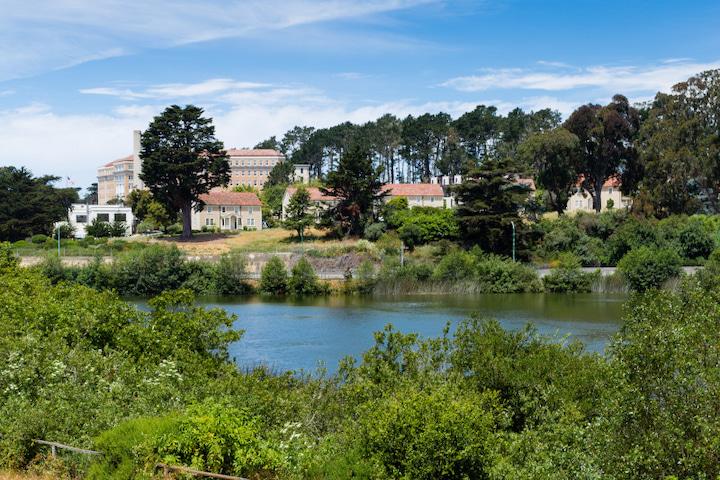
As one of the last remaining natural lakes in the city, Mountain Lake is a unique habitat within San Francisco. However, due to runoff from nearby Highway 1, an overabundance of non-native species, and an artificially shallow depth, its health has long been in decline, and a variety of the native aquatic plants and animals have disappeared. The Presidio Trust and its partners are spearheading the effort to revitalize this special place.
Dredging of the lake to remove contaminated sediment and increase the lake's depth will begin later this fall, followed by other enhancement activities. Before remediation begins, non-native turtles and fish, likely abandoned by pet owners, are being transferred to a refuge in Sonoma. The first part of the rescue effort took place in summer 2012 with the removal of only a small fraction of each species’ population. Even more fish are currently being rescued before the dredging takes place.
How Did Non-Native Animals Get in the Lake?
Mountain Lake is thought to house approximately 40 to 60 non-native red-eared slider turtles. A survey of the lake in 2007 by the California Academy of Sciences showed no evidence of the red-eared sliders breeding; therefore it is believed that all turtles in the lake are abandoned household pets. These turtles may live for up to 60 years, so some may have been living in Mountain Lake for decades.
There are two accounts of the native three spine stickleback fish living in the lake, noted in the 1860s and in 1928. However, none remain in the lake today. Instead, there are six species of non-native fish found there, including Common Carp (Cyprinus carpio, including Koi), Channel Catfish (Ictalurus punctatus), Spotted Bass (Micropterus punctalutus), Hitch (Lavina exilicauda), Fathead Minnows (Pimephales promelas), and Mosquitofish (Gambusia affinis). These, too, were likely once household pets released by their owners.
Why Does It Matter?
The non-native turtles and fish, numerous because they have no predators, tend to drive out native frogs and turtles by preying on their eggs and preventing the growth of aquatic plants that are necessary for the lake's health.
The rare Western pond turtle, the only native aquatic turtle on the West Coast, used to live in Mountain Lake, but has not been seen since 1966. Its numbers dwindled considerably in the 1800s due to the growing demand at local food markets. The subsequent introduction of pet turtles and other non-native species into the lake sealed the pond turtles’ fate. The red-eared sliders grow faster and larger than the western pond turtle, allowing them to outcompete for valuable resources like basking space. The sliders have flourished in the lake and pushed out the last remaining native pond turtles.
Shifting the "Sliders"
The effort to relocate the non-native red-eared sliders was undertaken in July 2012 by Jon Young, an ecological restoration intern with the Presidio Trust and graduate student at San Francisco State University. The turtles were captured through two types of humane, non-lethal traps. The first was a baited trap, which is a partially submerged net near the shore that lures turtles in through a conical entrance. The nets allowed plenty of room for the turtles to move once caught. The second type was a basking trap. This type of floating structure is built to mimic the types of logs where the turtles naturally take in the sun. Turtles climb up on to the rough outer edges of the trap and then slide into the trap along the smooth plastic inner edge. Inside the trap, basking space is provided for the turtle until it is retrieved.
“These traps take advantage of the turtles’ natural tendency to bask in the sun,” Young said. “The traps are simple, efficient, and most importantly out of reach of predators and people.”
After being safely kept in a holding pond, the turtles’ real journey began. Once a week during the turtle relocation, Young drove to the Sonoma County Reptile Rescue Center in Sebastopol to drop off the turtles. Al Wolf, who runs the rescue center, has already found homes for all the captured turtles. Private vineyards in Sonoma County have offered to take the turtles into their enclosed ponds where they can live out the rest of their natural lives on a permanent vacation.
To date, 42 red-eared slider turtles have been saved. A total of 23 adult carp and largemouth bass, as well as 8,000 to 10,000 juveniles, were also removed from the lake using gill nets, seine nets, fyke nets and electrofishing equipment.
Young sees the removal of the turtles as a valuable opportunity to educate the public and promote local stewardship of the lake. “People are beginning to understand the long term impacts of releasing their unwanted pets into a fragile ecosystem,” said Young. “This is an urban lake and its ongoing health will ultimately be in the hands of the local community.”